 Randolph
Recently I retired from my full-time role at Microsoft.
Owing to my position in the SQL Server community (something I will forever be grateful for), Brent Ozar created a YouTube video that addressed a question he received after writing about my departure in his weekly newsletter, and on LinkedIn.
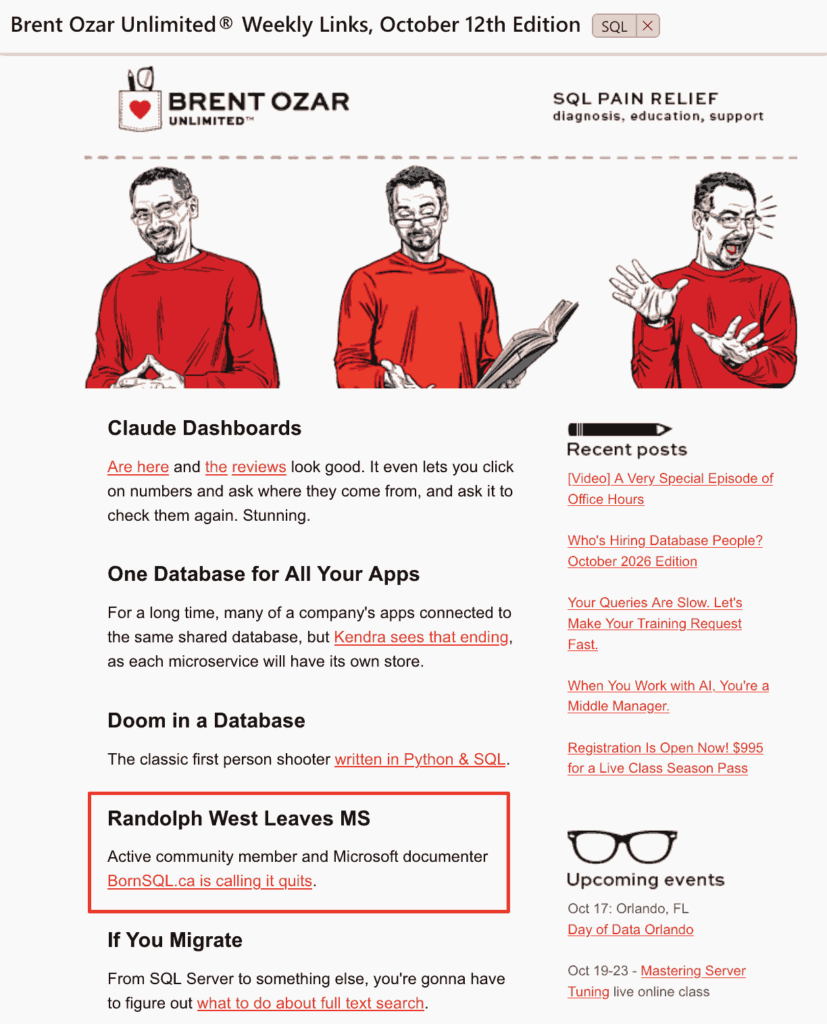
Specifically, someone questioned my pronouns. Since around 2015, I use they/them for a number of reasons. I have written extensively here about pronouns.
One person (whose comments have since been deleted because hate speech is still hate speech) kept yelling “performative virtue-signalling guilt” at everything I said.
Here’s my reply, with added links and emphasis to make it easier to find things.
I love this, Matthew. You’re obviously not talking about the album by Self Defense Family (though I do like track 2). It would be disingenuous of me to make assumptions about your motivations in order to score Internet points, eh?
Therefore you must be referencing Judith Butler’s work on how words shape actions, especially in the discussion of performativity and gender. I recommend an article by Sarah Lee from 2025 for those of you reading this who want to learn more. Butler’s theory is a fascinating exploration into what it actually means when we perform gender roles.
Of course it’d be wrong of me to assume that others have dived as deeply into this field as both you and I, Matthew, but I don’t want to alienate others. I am a teacher after all. Let’s learn together.
Like you, when I was growing up, society expected me to perform a gender identity that was bestowed upon me because I had external sex characteristics that are commonly associated with that role. Bimodal systems are messy, though. As you know, my fellow philosopher, Butler also notes that these gender identities—and their associated performances—can and do change. For example, if a parent dies, like mine did when I and my siblings were young, the other parent has to adapt, and take on non-traditional gender roles that aren’t associated with their external sex characteristics.
Now, what you know (because you seem to be extraordinarily insightful, Matthew), is that these roles don’t matter. None of it matters. No one is policing how I live, who I love, who I engage with intimately, or where I go to the toilet, as long as there’s informed consent. Right?
So in around 2015, I realized, like you, Matthew, that it’s all made up, and I decided that I was only lying to myself by trying to pass as a man. It just didn’t fit. The only performative guilt I sat with was that it took me so long to figure it out. I knew when I was ten years old that I was different. I performed a lie for nearly thirty more years, becoming increasingly at odds with society. So yes, I’m guilty of that. You nailed it on the head, my fellow philosopher.
For the last decade or so, I have become the person I want to be, and I get to decide how people address me. Mind you, as a political act it’s pretty exhausting. When I have to repeat myself multiple times to request that people use my correct pronouns, it gets noticed. I became a de facto figurehead because I’m NOT afraid of what it means for my career.
But as we’ve seen over and over again, it disrupts existing brain patterns. It breaks IT systems. It brings out comment trolls on YouTube. If I could have chosen a less disruptive life, I would have. My gender identity is a performance, by Butler’s definition. But Matthew, so is yours. I don’t wake up and think “time to be trans”. I wake up and think “thank goodness I don’t have to pretend anymore”.
Let’s actually get to the point here. The fact that a non-binary queer person was the content lead for SQL Server documentation at Microsoft is a big deal. It’s also political by my very existence. I didn’t ask Brent to make this video. I didn’t ask you to watch it. I didn’t ask you to comment repeatedly and negatively either. Yet here you are, smug and cocksure.
But guess what? I have read a few books in my time. I have in fact (co-)written five books of my own, and I highly recommend that you read my chapter in LET THEM FINISH.
I know what words mean. I know that words can injure, and words can love. I want to choose kindness as often as I can.
I want to remind you that Alan Turing died because of homophobia, and he invented the modern computer that shortened the Second World War by two years and that you and I both use today. There’s at least one SQL Server instance between you and me, and I owned the documentation for that product. You’d be hard pressed to find an article in that corpus I didn’t edit. The fact is, Matthew, 2SLGBTQI+ people are in your life whether you like it or not.
See me for who I am. I will not go back into the closet because you feel uncomfortable. I will not be quiet while you use words you don’t understand. It’s bad enough that I have to watch straight people perform their gender in public. Try not expose your ignorance too.